
The three paths
The second step when you create your player is choosing a path. It decides your starting level, how far you can go and what kind of club you start your career at.
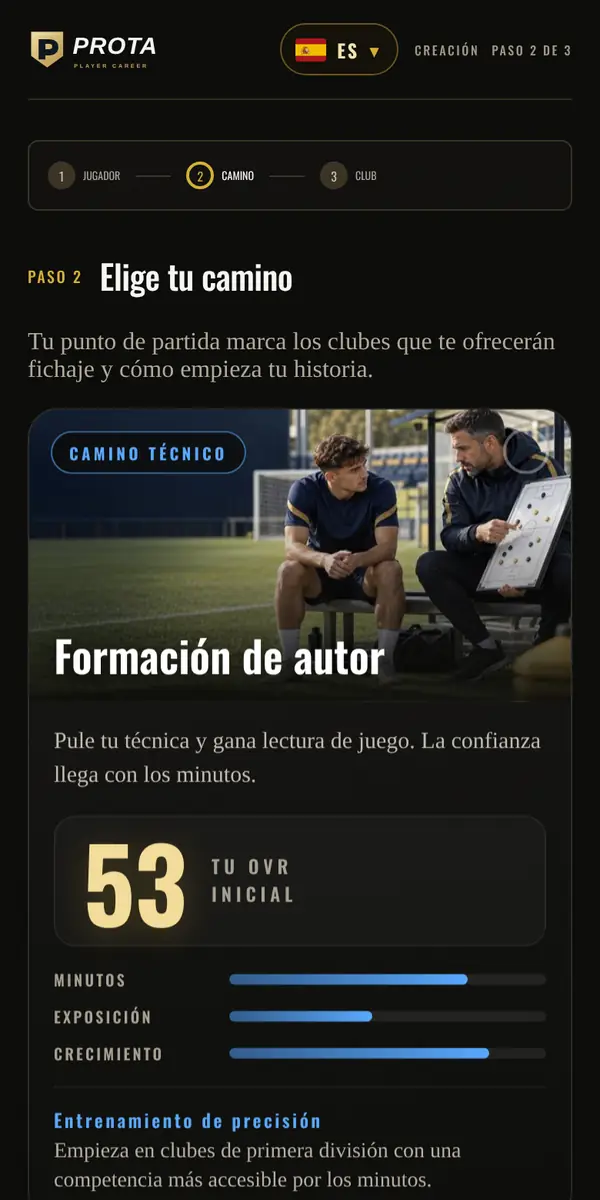
| Path | Starting OVR | Highest ceiling | Where you start |
|---|---|---|---|
| Technical ("Author's training") | 53 | up to 89 | Mid-table and top first-division clubs (levels 3 and 4) |
| Balanced ("Grow at your own pace") | 55 | up to 91 | Level 2 clubs, almost always in a second division |
| Ambitious ("The big bet") | 57 | up to 94 | The biggest clubs in Europe (level 5) |
The "highest ceiling" is the best possible case. Every career also has a hidden talent that can lower that ceiling by up to 26 points, although never below your starting OVR plus 8. That is why two careers on the same path can end very differently.
Technical path: precision and patience
You start at a first-division club, but not one of the giants. There is competition, although it is easier to earn minutes than at a big club. It is a path for anyone who wants to play in a top flight from the start without risking so much.
Its ceiling is the lowest of the three, but it is still very high: with good hidden talent you can become a world star.
Balanced path: growing without pressure
You start at a level 2 club. It is almost always in a second division (LaLiga Hypermotion, EFL Championship, Serie B, 2. Bundesliga, Ligue 2, Eerste Divisie or Liga Portugal 2), although it can also be one of the smallest clubs in the Dutch or Portuguese top flight. At these clubs you play a lot from a young age, which is exactly what makes your OVR grow.
It is the most recommended path for a first career. Minutes come early and, if you perform, first-division offers appear within one or two seasons.
Ambitious path: all or nothing
You start at a level 5 club, the elite of Europe, with the highest starting OVR and ceiling. You also start with more ambition in your personality. Trophies come far more often: a big club wins its league roughly one season in three.
The problem is minutes. An elite club asks for a very high level to start. Even though they ask less of young players, it is easy to spend your first seasons on the bench. If that happens two years in a row, your progress stalls. Many players on this path go out on loan or sign for a smaller club to come back stronger.
Choosing your first club
After the path, you choose a club among nine random options from your group. You can filter by country and league. Think about two things:
- The club's level: the higher it is, the more trophies but the fewer minutes.
- The competitions: first-division clubs play their league, their cup and sometimes European competitions. Second-division clubs don't play in Europe.
You can see every club and its level in the leagues, country by country.
Our recommendation
If it is your first career, choose the balanced path. If you already know the game and want strong emotions, try the ambitious one. And if you want a middle ground, the technical path puts you in a first division from day one.